Discovery
1 weekWe start with a kick-off meeting about your charity's goals and the people your website needs to work for, then research similar organisations, so each audience gets a clear route to what they need.
We build accessible charity websites, so more people can find you, support you and get involved.
Your website is often the first place people meet your charity. It needs to help you reach the people your services are for, raise the money that keeps them running, and bring in the volunteers and partners who make the work possible.
The people you want to reach use the web in different ways, and your website should be designed to work with each of them. For a charity, an inclusive website is your values put into practice online. It’s also the standard we hold our own work to: every site we build is designed and tested to WCAG 2.2 AA, the recognised guidelines for web accessibility.

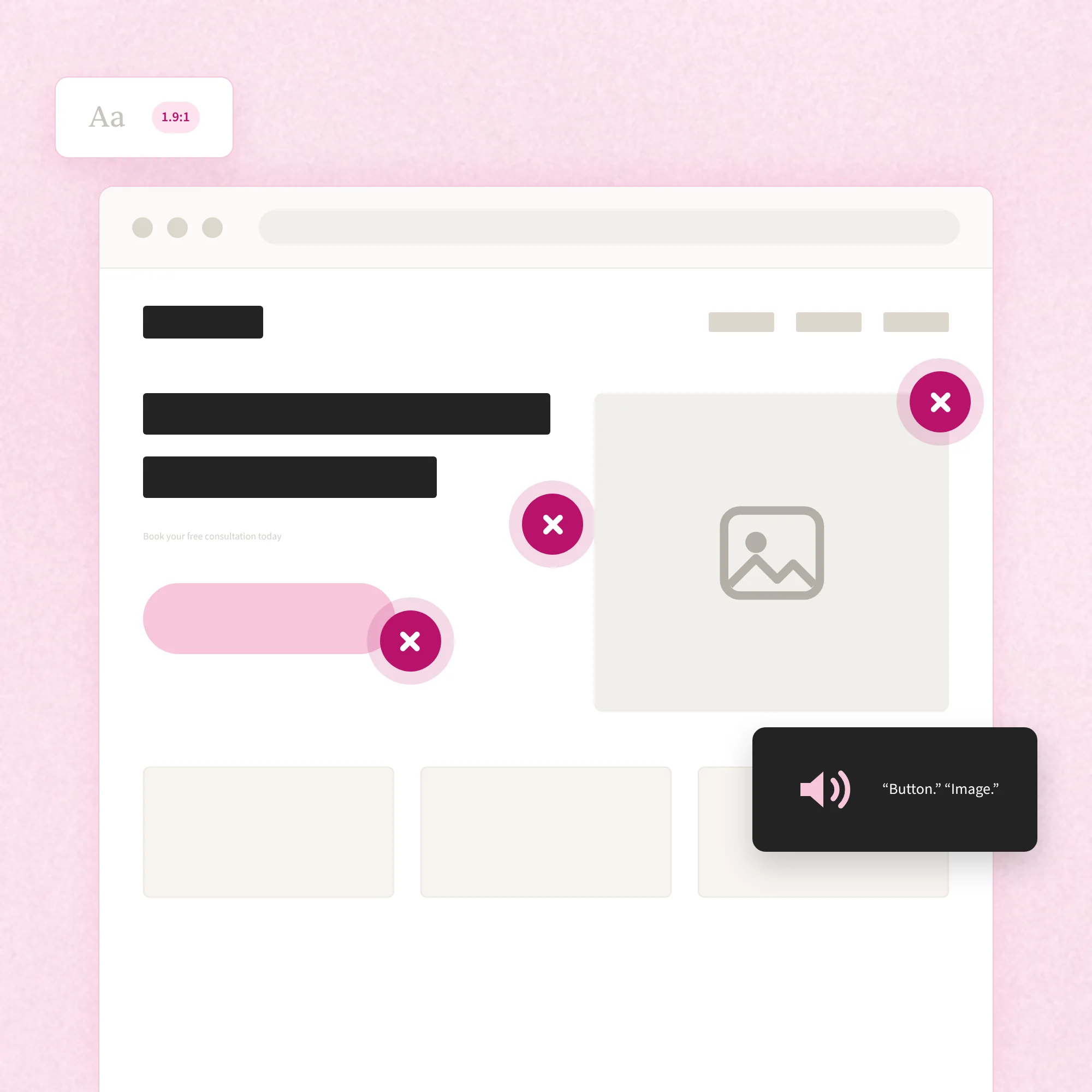
Our accessibility report found more than half of the charity websites we tested in our lowest band. These problems came up most often.
Low colour contrast makes pages hard to read, so people miss what you offer.
Menus and forms that need a mouse stop keyboard, voice and switch users.
Dense pages and complicated language get in the way of the people you serve.
A page can look clear but make no sense read aloud by a screen reader.
Plugins and toolbars can't change how a website was built.
Around one in four people in the UK have a disability. Our free check scores your website out of 100 in under a minute and shows you what to fix first.
After talking with Squee and realising how useless accessibility plugins can be, it was clear our website was not inclusive at all! Thanks to Squee, we've now taken our first step by offering the ability to browse our menu with your keyboard. It seems like a small addition to the user experience but it's a big step for me that I am proud we are taking as we aim to make our website more accessible and inclusive following the WCAG Guidelines.
From sitemaps and moodboards to designs and testing, we keep your trustees, staff and volunteers involved every step of the way.
We start with a kick-off meeting about your charity's goals and the people your website needs to work for, then research similar organisations, so each audience gets a clear route to what they need.
We develop a clear structure for your website, creating wireframes that map out the journeys for people using your services, supporters and volunteers, so content is easy to find.
We bring your charity website design to life with high-fidelity mockups that reflect your brand. We focus on accessibility, aesthetics and usability, so the design is inclusive and easy to use.
With the design approved, we move into charity website development, building a responsive WordPress website with clean, accessible code that your team can update themselves.
We test across browsers and devices, with accessibility checks by hand using a keyboard and screen reader. Then we launch your charity website and monitor it to make sure everything works as intended.
After launch, we offer ongoing support to maintain and update your charity website, including regular maintenance, performance monitoring and content changes.
The things people ask us before they get in touch. If yours is not here, just ask.
Ask a questionYes. We customise every page to your organisation, so there’s no complicated page builder, just a simple form for each section. Your team can update pages, news, events and appeals without any coding, and if you’re on one of our support plans, an AI helper built into your website can talk you through any change.
Yes. We map out each journey, from donating to booking an event or signing up to volunteer, and make every step as simple as possible, whether that’s a form on your website or a connection to a platform you already use. And if your charity needs something else, like a members area or a resource library, we can build that too.
Yes. Not every charity needs a new website. We can audit what you have, prioritise the fixes that make the biggest difference to people using it, and work through them with you.
In most cases, yes. The Equality Act 2010 applies to charities as service providers, and your website is one of your services. Charities that are mostly publicly funded, or that provide services essential to the public or aimed at disabled people, can also fall under the stricter public sector accessibility regulations.
Most charity websites take around 7 to 8 weeks, from the kick-off meeting to launch. The biggest factor is usually how quickly content and sign-off come together, so we plan the timeline around your team.
It depends on the scope of your project, so we start by sitting down with you to understand exactly what your website needs to do, then send a tailored proposal. As a guideline, most charity websites fall between £3,000 and £10,000, and charities get 10% off.
It’s less about the builder and more about how the website is coded, because that’s what decides how accessible it is. We build every website by hand to WCAG 2.2 AA, with WordPress as the backend, so you get an easy way to manage your content without being limited by a builder’s templates.
Opinion 7 min read
1.3 billion people live with a disability, and most websites still get in their way. Here are the numbers.
Digital Accessibility 11 min read
In case you hadn't realised.. at Squee, we love and champion website accessibility. Now, while we could dive into the real technical…
Digital Accessibility 4 min read
Designing with accessibility in mind is more than a best practice; it's a commitment to equal access and user-centric design. At Squee,…
Research 12 min read
We assessed 50 Gloucestershire websites, from charities to the county’s largest organisations. Here is what we found.
Run our free accessibility check and get a scorecard in under a minute. It shows what is working, what is getting in people’s way, and what to fix first.